The Menopause Brain Toolkit

Track it.
Understand it.
Get taken seriously.

Twelve printable pages for the months when your memory, your focus and your sleep stop behaving: a 30-day tracker, the exact sentences to say to your doctor, and a plan for the 3 a.m. wake-ups. Every fact comes with its source.

$27One payment · PDF sent to your email
Get the toolkit

The toolkit goes on sale in a few days. Start with the free tracker in the meantime.

Three jobs

It does the three things that make an appointment useful.

Track

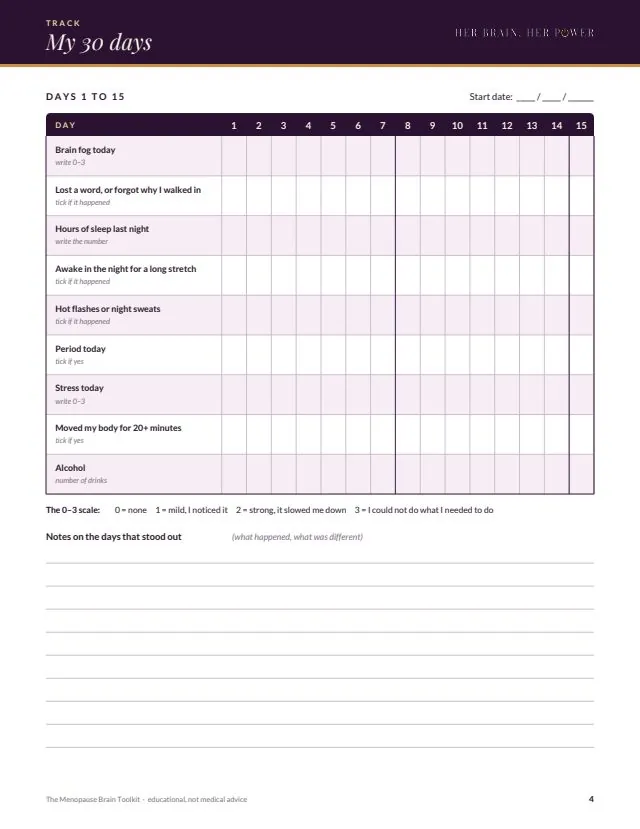
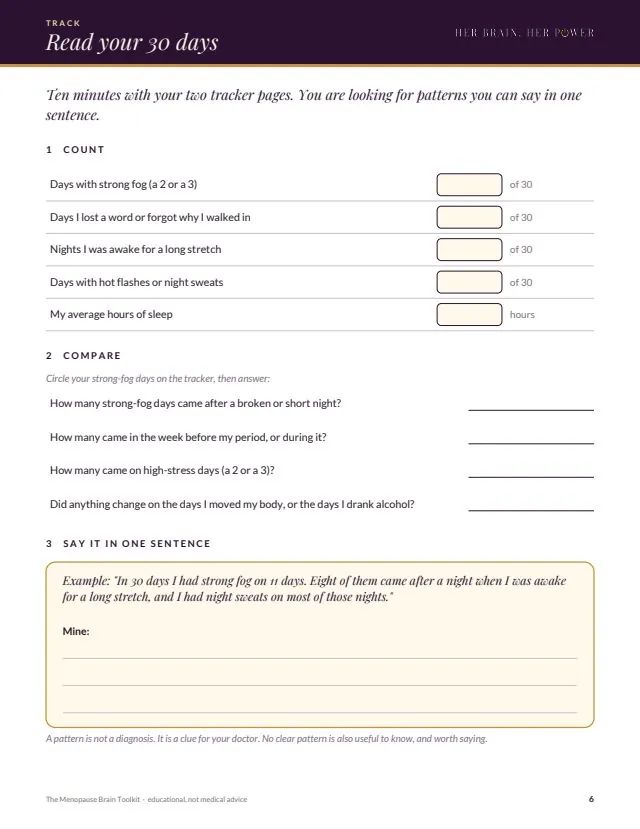
Thirty days of notes in about 30 seconds an evening, then one worksheet that turns them into a pattern you can say in one sentence.


Talk

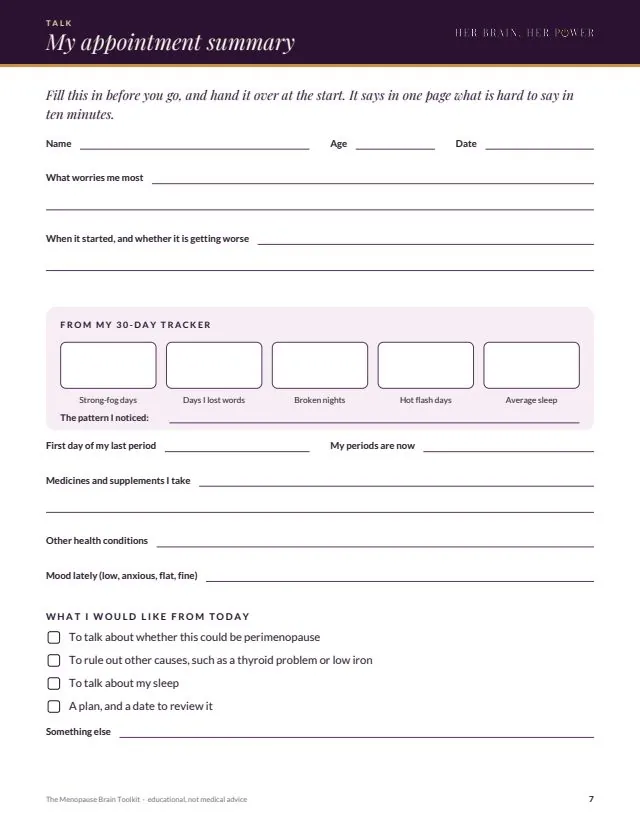
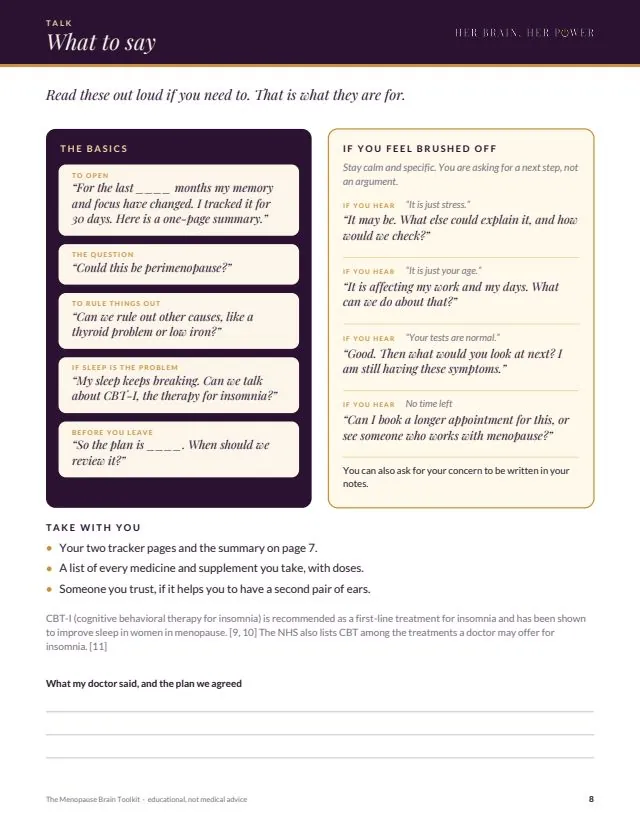
A one-page summary to hand over at the start, the sentences to say, and what to say when you hear “it’s just stress”.

Sleep

What to do when you are wide awake at 3 a.m., and a seven-night sleep diary to bring with you.

Inside
Twelve pages. Nothing to read twice.

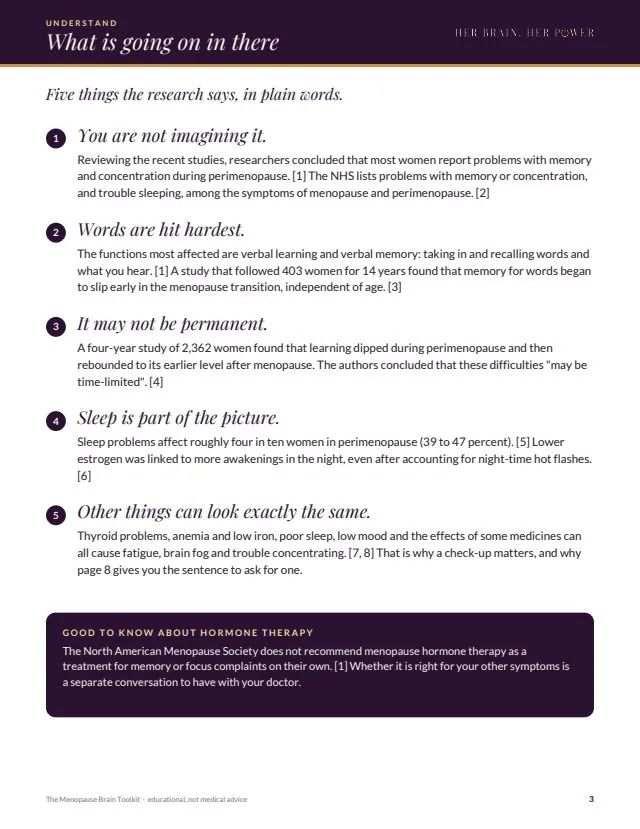
Toolkit page: five things the research says
What is going onFive things the research says, in plain words.
Toolkit page: the 30-day tracker
The 30-day trackerNine things to note, on two pages.
Toolkit page: read your 30 days
Read your 30 daysCount, compare, and say it in one sentence.
Toolkit page: appointment summary
Appointment summaryOne page to hand to your doctor.
Toolkit page: what to say
What to sayThe basics, and what to say if you feel brushed off.
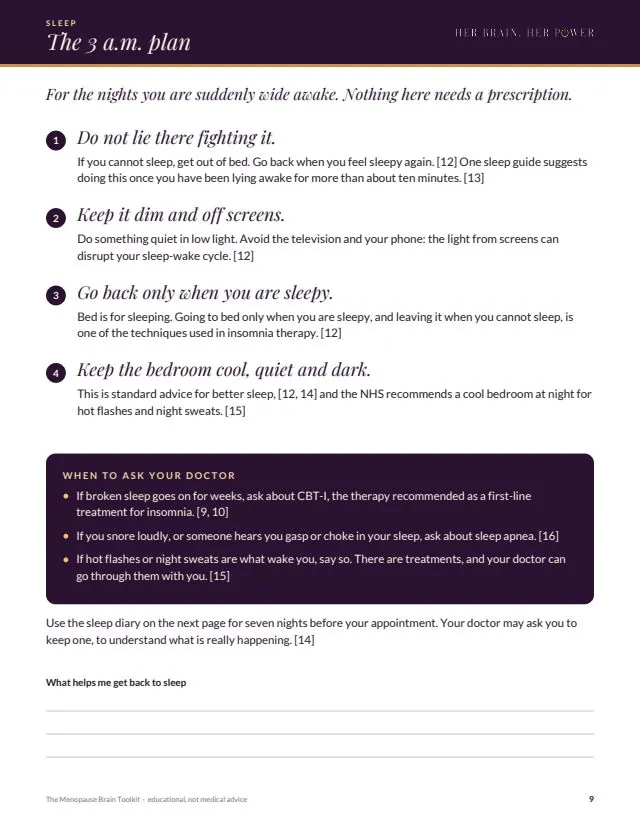
Toolkit page: the 3 a.m. plan
The 3 a.m. planFour steps, and when to ask for more help.
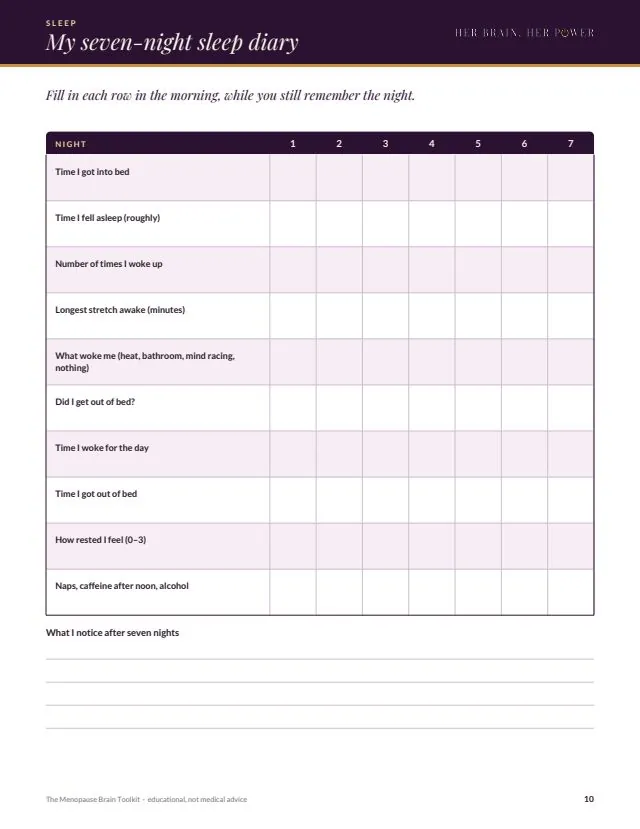
Toolkit page: seven-night sleep diary
Sleep diarySeven nights, filled in each morning.
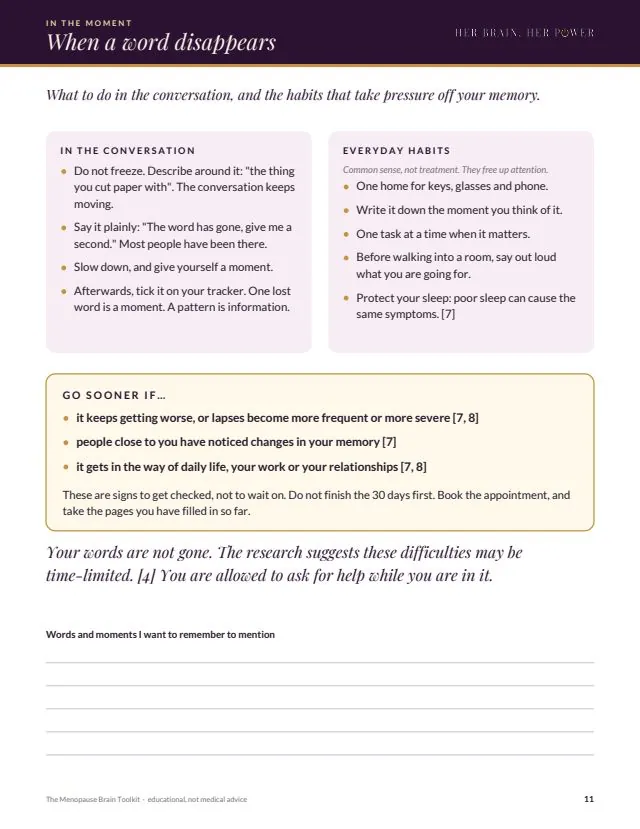
Toolkit page: when a word disappears
When a word disappearsWhat to do in the moment, and when to go sooner.

Honest about what it is

A tool for a better conversation. Not a cure.

It is for you if

  • you are in your forties or fifties and your memory, focus or sleep has changed
  • you have an appointment coming, or you keep putting one off
  • you have been told it is “just stress” and want to come back with notes
  • you like pen and paper

It is not

  • a diagnosis, or a test for perimenopause
  • a treatment, a diet or a supplement plan
  • a replacement for seeing a doctor
  • a promise that your symptoms will go away

The research

Sixteen sources, listed on the last page.

Each factual line carries a number that points to where it comes from: published studies, and health bodies including the NHS, the US National Institutes of Health and the CDC. Where the research is uncertain, the toolkit says so. Her Brain, Her Power is independent: it is not affiliated with, or endorsed by, any of the organisations it cites.

For example: a four-year study of 2,362 women found that learning dipped during perimenopause and rebounded afterwards, and its authors concluded the difficulties “may be time-limited”. The toolkit tells you that, and where to read it.

Questions

Before you buy

How do I get it?

It is a PDF. After you pay, the download link is sent to your email address straight away.

Can I print it at home?

Yes. It is laid out for US Letter paper and also prints well on A4 if you choose “fit to page”. Pages 4 to 10 are the ones to print.

Is this medical advice?

No. It is educational. It cannot tell you what is causing your symptoms and it does not replace a visit to a health professional. If something is getting worse, see a doctor now.

How is it different from the free tracker?

The free tracker is one page for two weeks. The toolkit covers 30 days, adds the worksheet that finds your patterns, the summary page for your doctor, more scripts, the 3 a.m. plan and the sleep diary.

The Menopause Brain Toolkit

Walk in with notes. Walk out with a plan.

$27

Get the toolkit

One payment. PDF sent to your email. Educational, not medical advice.